
EDRi-gram, 19 November 2026
What has the EDRi network been up to over the past few weeks? Find out the latest digital rights news in our regular newsletter. In this edition: Making sense of the Digital Fairness Act, a very unmerry birthday to the Digital Omnibus, and more!
Do you want to receive all the latest news from the digital rights world?
SUBSCRIBE NOW TO THE EDRi-GRAM!
Dear supporters,
Last week, the European Commission put digital fairness on the menu with a proposal for its long-awaited Digital Fairness Act (DFA) – and we have some food for thought.
This law will strengthen consumer protection against manipulative and exploitative commercial practices, such as fake notifications designed to keep bringing us back to an app, endless scrolling that keeps us online way longer than you intended, and other personalised techniques used by online services that exploit our vulnerabilities. First things first, proposal actually takes some important steps forward by introducing new prohibitions on deceptive design, extending specific protections beyond the biggest online platforms, and recognising the harms associated with addictive digital features. However, we were left wondering – why promise digital fairness yet leave the users to do all the work instead of holding manipulative online services responsible? Read our analysis on Tech Policy Press.
Despite it all, the DFA proposal – something that actually might protect our rights online – is a welcome respite in the current wave of deregulation in the EU. This week, we’re also reckoning with the fact that November 19, 2026 marks one year since the Commission published the proposals for the Digital Omnibus. We, along with many other civil society organisations, had warned that this would be a massive reopening of EU’s core digital protections that would risk dismantling the very foundation of human rights and tech policy in the EU. One year on, it seems like we were granted Apollo’s gift of prophecy. On this unfortunate occasion, we’re standing strong with 100 organisations, experts, academics and more to urge EU lawmakers to not simplify away our rights.
In this edition, you can also explore our extremely thorough guide to the European Parliament’s 1840 amendments to the Digital Omnibus on Data, focusing on what they would mean for privacy, data protection and, ultimately, people’s rights. Yes, 1840, you read that right. Hungry for more? Also read our thoughts on the EU governments’ position on the Digital Omnibus.
-

1,840 amendments, one basic question: will the Data Omnibus simplify EU digital rules or weaken people’s rights?
The European Parliament is considering 1,840 amendments to the Digital Omnibus on Data, a proposal that would change the General Data Protection Regulation (GDPR), ePrivacy and other parts...
-
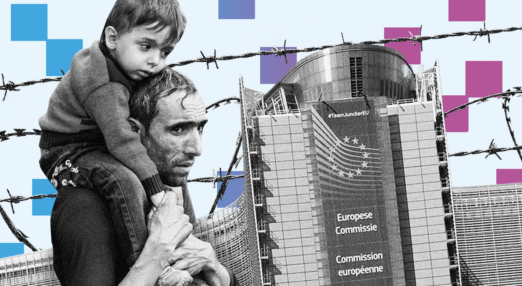
EU transforms Frontex into a high-tech deportation command centre
On 27 October 2026, the European Commission tabled a new Regulation for Frontex, the EU's border agency, expanding its powers and refocusing its mandate on deportations, preventing arrivals,...
-

EU governments call it ‘simplification,’ but their Data Omnibus deal considerably weakens our rights
EU governments have agreed on their position on the Digital Omnibus, retaining changes that threaten fundamental rights to privacy and data protection. With negotiations moving to the European...
-

Data retention is mass surveillance of people’s phone and internet activity
In 2014, the Court of Justice of the European Union (CJEU) declared mass retention of internet traffic and location data as contrary to the EU Charter of Fundamental...
-

Open Letter: EDRi warns of EU’s undemocratic attempt to introduce surveillance in satellite-based communications
The European Parliament and the Council of the European Union are currently negotiating two laws to regulate communications service providers, including satellite-based ones. In both laws, the Commission...
-

New report documents authoritarian use of technology across the globe
Privacy International's latest report documents how states are deploying authoritarian technology to stifle dissent, assert control and diminish human rights. The report conveys how surveillance technologies are being...
Donations from readers like you help us to publish the EDRi-gram and bring you the most important digital rights news.
DONATE TODAY
RECOMMENDED
[📰 read] Public Procurement Act: Europe needs control over its digital infrastructure by Free Software Foundation Europe. The EU rules on how public money is spent are about to be reformed. In the European Commission’s proposal for the Public Procurement Act, free- and open software are explicitly recognised for their contribution to innovation objectives. In this article, EDRi-member Free Software Foundation Europe explains how the proposal should be improved if Europe truly wants to gain control over its digital infrastructure.
[📺watch/listen] Regulator or Accomplice? How New Laws May Support Old Ambitions by The Maybe. What happens when governments act as both regulators of technology companies and partners in deploying technologies that can threaten rights and privacy? In this talk, Evelyn Austin, Executive Director of EDRi-member Bits of Freedom, Elisa Lindiger, Managing Director of EDRi-member SUPERRR, Sarah Chander, and Asha Allen unpack this tension and explore how civil society and coalitions can navigate the power dynamics between governments and Big Tech – and what it will take to build accountability across both.
[📰 read] The Big Tech campaign to kill data protection in Europe by Corporate Europe Observatory. In November 2025, the European Commission presented the Digital Omnibus proposal to simplify EU digital regulation. Since its publication, the Digital Omnibus has been heavily lobbied by Big Tech to push for deregulation and weaken data protection. In this analysis, Big Tech’s lobby campaign shaping the Digital Omnibus is examined through Freedom of Information requests, showing that the result could be very good news for the tech oligarchs, and not just bad news for our data privacy, but also a dramatic defeat for European digital sovereignty.
[🏃🏿 do] On 16 September, the European Commission presented the KIDS ACT, its plan for making online experiences safer for young people. Far from being a move to lead the EU towards better digital environments, this move is a missed opportunity to address the root cause of why online platforms are harmful to children – and everyone else. Until 03 December, the proposal is open for public input. We prepared some inspiration for you here.
EVENTS
-
International Digital Rights Days
Digital rights are human rights. In a society increasingly shaped by the digital world, it is essential to emphasize the importance of everyone’s right to access, use, and...
-

IGF 2026 – Internet Governance Forum
The 21st annual meeting of the Internet Governance Forum will be held in Nairobi, Kenya, marking the first gathering of the global multistakeholder community since the UN...
-

Digital Rights Monthly Socials
Connect with the global digital rights community at the monthly Digital Rights Social, hosted by Team CommUNITY on their virtual Mattermost platform
-
40th Chaos Communication Congress (40C3)
Between Christmas and New Year's Eve, the Chaos Computer Club hosts its annual Chaos Communication Congress, a Europe-wide renowned gathering attracting more than 17,000 participants annually.
-
FOSDEM 2027
FOSDEM is a free event for software developers to meet, share ideas and collaborate. Every year, thousands of developers of free and open source software from all over...
-

CPDP 20th international conference
CPDP (“Computers, Privacy and Data Protection”) is a non-profit platform founded in 2007 by research groups at the Vrije Universiteit Brussel, the Université de Namur, and Tilburg University,...
-
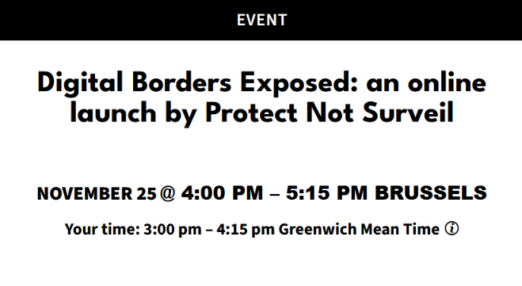
Digital Borders Exposed: an online launch by Protect Not Surveil
The Protect Not Surveil coalition is proud to launch Digital Borders Exposed, an interactive online tool that exposes the European Union’s digital surveillance infrastructure, which is enabled...
-

Brussels Campaign Exchange on ‘Building Movements, Building Power’
Future Advocacy is thrilled to invite you to the next Brussels Campaign Exchange on ‘Building Movements, Building Power’, taking place 18:00-20:00 on the 26th of November in Mundo...
JOBS
-

7amleh is hiring for Admin and Finance Officer – France
7amleh - The Arab Center for the Advancement of Social Media is a non-profit organization that advocates for Palestinian digital rights. 7amleh’s mission is to create a safe,...
-

The Center for Countering Digital Hate (CCDH) is hiring for for Digital Fundraising and Growth Strategist
The Center for Countering Digital Hate (CCDH) is a non-profit organisation dedicated to disrupting the architecture of online hate and misinformation. Through evidence-based research, policy advocacy and strategic...
-

ONE is looking for a Policy and Advocacy Manager, Italy & Netherlands
ONE is a global, nonpartisan organization fighting for a more just world by demanding the investments needed to create economic opportunities and healthier lives in Africa.
-

noyb is hiring for a GDPR Litigation Lawyer
Noyb pursues strategic and effective enforcement by thoroughly analyzing and prioritizing privacy violations, identifying the legal weak spots of these cases and litigating them with the best possible...