
EDRi-gram, 28 May 2026
What has the EDRi network been up to over the past few weeks? Find out the latest digital rights news in our bi-weekly newsletter. In this edition: May the force be with the digital rights community.
Do you want to receive all the latest news from the digital rights world?
SUBSCRIBE NOW TO THE EDRi-GRAM!
Over the past several weeks, Brussels has continued pushing policies that expand data collection and strengthen policing powers, all while presenting them as necessary for security. Talks on the highly controversial EU deportation regulation collapsed on 21 May after negotiators failed to agree on when the new rules should enter into force, but the political direction remains unmistakable: more deportations, increased surveillance, faster procedures, and broader enforcement powers.
Meanwhile, the EU’s much-hyped “tech sovereignty package” appears stuck in transit. The European Commission has once again postponed the long-awaited proposals amid tensions over trade negotiations with the United States. Officially, the package is said to be “ready” but a crucial part of it, the EU’s new Open Source Strategy, has been quietly removed. This will leave a major gap in Europe’s path for digital self-determination.
And while negotiations on the above unfold, Meta quietly announced it will remove end-to-end encryption from Instagram messages on 8 May, meaning your messages to friends and loved ones on one of the world’s largest platforms will no longer be fully secure.
Resistance, however, is growing too. Join us to call on lawmakers to protect encryption and safeguard our ability to safely and securely communicate with each other.
In this edition, we look at the political spin surrounding the European Parliament’s vote on children’s online safety, unpack the dangers posed by spyware, and dive into new research on how the implementation of the Law Enforcement Directive is still ineffective. We also cover the backlash against a Czech football club’s attempt to introduce facial recognition in stadiums, a controversy that exposed just how normalised biometric surveillance is becoming across Europe.
As governments and corporations continue to present invasive technologies as inevitable, the fight over privacy, accountability, and democratic freedoms is happening daily, in our phones, at our borders, online, and now, even in football stadiums.
PS. As digital rights increasingly collide with political polarisation, disinformation, and social conflict, the need for strategies and expertise follows along. That’s why EDRi is looking for conflict prevention and resolution professionals to help strengthen the movement and build more resilient democratic spaces across Europe. More details here.
-

Did the EU Parliament really vote not to protect children online?
In April 2026, negotiations on the ‘interim ePrivacy derogation’ fell apart, with several stakeholders claiming that the European Parliament stopped the EU from protecting children. In reality, however,...
-

Research study: Evaluation of EU’s Law Enforcement Directive shows implementation still fragmented and insufficient
This study commissioned by EDRi analyses the implementation of the Law Enforcement Directive (LED) in five EU Member States. It shows that even eight years after the LED’s...
-

Inside Italy’s low-cost spyware economy
Commercial spyware in Europe has recently made headlines with the now notorious names of Pegasus and Graphite, the expensive, exploitation-driven products at the top end of the market....
-

Ireland investigates Meta for breaching the DSA – a year on from our complaint
The Irish Digital Services Coordinator Coimisiún na Meán (CnaM) has announced a formal investigation last week into whether Meta breaches the DSA’s obligation to offer users access to...
-

What’s behind the EU’s digitalisation push? Surveillance, control and exclusion
The EU institutions have been engaged in a broad and wholesale digitalisation project but underneath the rhetoric of efficiency, modernisation, and citizen empowerment lies a more troubling reality....
-

A push back to Czech football club‘s plan to install facial recognition CCTV system
There is a debate in the Czech Republic over the use of facial recognition cameras in stadiums. Both clubs and politicians are calling for biometric surveillance after hundreds...
Donations from readers like you help us to publish the EDRi-gram and bring you the most important digital rights news.
DONATE TODAY
RECOMMENDED
- [📺watch] Looking the other way by Human Rights Watch. Increasing government use of commercial spyware and other types of surveillance technology poses a significant threat to human rights worldwide, undermining the work of different voices challenging power. Human Right Watch found that EU Member States have been exporting this dangerous technology to governments with with history of surveillance-fuelled harms, despite EU laws being in place.
- [📰read ] EU-US data exchange proposal in conflict with EU laws by Statewatch. Since last December, the EU and the US have been negotiating an agreement to exchange information for security screenings and identity verification related to border procedures and visa applications. Statewatch published and analysed the European Commission’s current proposal, which manifestly violates EU law. It goes beyond the limited negotiating mandate of the Commission and against essential data protection safeguards set out by the European Data Protection Authorities, exposing all travellers to automated discriminatory profiling and safety threats.
- [📰read ] Palestinian exclusion from the digital economy is structural and systematic by 7amleh. 7amleh’s latest report highlights the systematic exclusion Palestinians face in accessing global digital platforms, including payment services, e-commerce, and remote work platforms. Based on an analytical methodology, it was found that Palestinians in the West Bank, Gaza Strip, and inside Israel face structural barriers that restrict their participation in the digital economy. These barriers are shaped by the intersection of global tech company policies and Israeli control over ICT infrastructure, limiting access to essential economic tools.
EVENTS
-

DRAPAC26 – Digital Rights Asia-Pacific Assembly
The 2026 Digital Rights Asia-Pacific Assembly (DRAPAC26) brings together changemakers from across the region working at the intersection of digital rights, human rights, and technology.
-

Resistance Lab: Making and distributing media under surveillance
Join Interrupting Criminalization's Abolition Journalism Fellow Lewis Raven Wallace, digital security firm Safety Sync Group, and fellow journalists and media makers for a resistance lab.
-

Digital Rights Monthly Socials
Connect with the global digital rights community at the monthly Digital Rights Social, hosted by Team CommUNITY on their virtual Mattermost platform
-

Announcing the Summit “Fight for Us, not for Them”: A public interest vision for EU tech policy
Europe’s approach to governance for advancing technology in the digital age is under pressure, with “simplification” proposals hitting the heart of core digital protections. At the same time,...
-
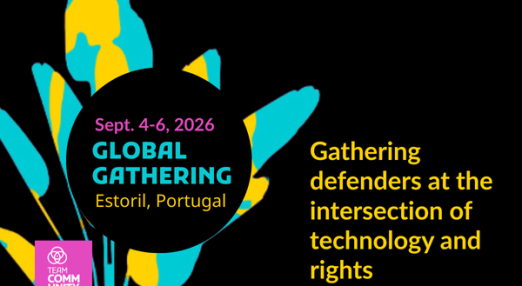
Global Gathering 2026
The Global Gathering brings together groups from around the world working on the most urgent technology-related challenges affecting human rights, social justice, civil society, and journalism at the...
-

EU DisinfoLab 2026 Annual Conference
The counter-disinformation community will meet for #Disinfo2026 in Vilnius, Lithuania. The main conference days on 7–8 October 2026 will feature a full programme of sessions in a variety...
-

Conference Digital Commons: Infrastructures, Design, and the Ethics of Autonomy
Digital Commons: Infrastructures, Design, and the Ethics of Autonomy is an international conference exploring how digital infrastructures shape contemporary life, and how communities, researchers, and technologists imagine and...
JOBS
-

7amleh is hiring for Admin and Finance Officer – France
7amleh - The Arab Center for the Advancement of Social Media is a non-profit organization that advocates for Palestinian digital rights. 7amleh’s mission is to create a safe,...
-

MenEngage Alliance is hiring for an Advocacy Officer
MenEngage Alliance is a global network of civil society organisations and United Nations agencies working with men and boys to advance gender equality, sexual and reproductive health and...
-

Lighthouse Report is hiring for a Editor, Climate and Environment
Lighthouse Reports is an award-winning nonprofit newsroom that undertakes public interest investigations in partnership with some of the world’s leading media.
-

Freedom of the Press Foundation is hiring for a Research Reporter, USPFT
Freedom of the Press Foundation (FPF) is a non-profit organization that protects, defends, and empowers public-interest journalism in the 21st century.
-

Amnesty International is hiring for a Governance Coordinator
Amnesty International is a global movement of more than 10 million people who take injustice personally. They are campaigning for a world where human rights are enjoyed by...
-

The Center for Democracy and Technology is hiring for a Senior Policy Analyst/Counsel, Privacy & Data Program
The Center for Democracy & Technology (CDT) is a non-profit organisation working to promote democratic values and protect fundamental rights in the digital age. CDT advocates for human...
-

International Press Institute is hiring for a Press freedom editor/editorial lead
IPI was founded in 1950 by 34 editors from 15 countries who believed in the power of the free flow of information to promote peace. Today it is...
-
ICCL is hiring for an Enforce Artificial Intelligence Expert
The Irish Council for Civil Liberties (ICCL) is the foremost civil liberties organisation in Ireland with a long and successful track record of defending human rights and civil...