
Blogs
Filter by...
-

Facial recognition and fundamental rights 101
This is the first post in a series about the fundamental rights impacts of facial recognition. Private companies and governments worldwide are already experimenting with facial recognition technology. Individuals, lawmakers, developers - and everyone in between - should be aware of the rise of facial recognition, and the risks it poses to rights to privacy, freedom, democracy and non-discrimination.
Read more
-

Shedding light on the Facebook content moderation centre in Athens
Following months of efforts, in early September 2019, EDRi observer Homo Digitalis managed to shed light on a case that concerns each and every Facebook user: a content moderation centre in Athens, Greece, tasked to moderate Facebook ads. As many other content moderation policies run by virtually unaccounatable private companies, this can pose threats to […]
Read more
-

New Protocol on cybercrime: cutting red tape ≠ cutting human rights safeguards
From 20 to 22 November 2019, European Digital Rights (EDRi) and the Electronic Frontier Foundation (EFF) took part in the Octopus Conference 2019 at the Council of Europe (CoE) to present the comments submitted by EFF, EDRi, IT-Pol Denmark and the Electronic Privacy Information Center (EPIC) on draft provisions of the Second Additional Protocol to […]
Read more
-
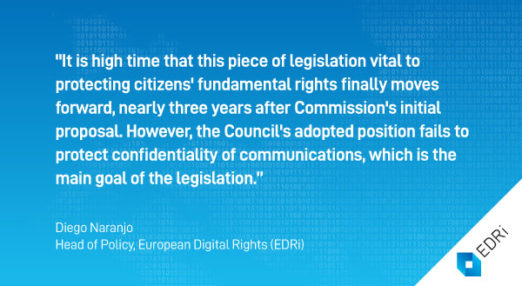
EU Council moves the ePrivacy reform forward – with major flaws in its position
Read more
-

ePrivacy: EU Member States push crucial reform on privacy norms close to a dead end
Today, on 22 November 2019, the Permanent Representatives Committee of the Council of the European Union (COREPER) has rejected the Council’s position on a draft ePrivacy Regulation. “In this era of disinformation and privacy scandals, refusing to ensure strong privacy protections in the ePrivacy Regulation is a step backwards for the EU,” said Diego Naranjo, […]
Read more
-

A privately managed public space?
Our “public spaces” online where we meet each other, organise, or speak about social issues, are often controlled and dominated by private companies (platforms like Facebook and YouTube). Pushing platforms to decide which opinions we are allowed to express and which not is not going to solve major problems in our society. The EU rules […]
Read more
-

Dance. Enjoy. Share. With Care.
Anyone using cloud services should be aware of what the “cloud” is, what it is not, and how it can affect our privacy and security. Our information stored in “clouds” can be protected if the EU says “Yes!” to a strong ePrivacy Regulation, greater enforcement of the General Data Protection Regulation (GDPR), and drops the […]
Read more
-

ePrivacy hangs in the balance, but it’s not over yet…
Unless you have been living under a rock (read: outside the “Brussels bubble”) you will likely be aware of the long and winding road on which the proposed ePrivacy Regulation has been for the last three years. This is not unusual for a piece of European Union (EU) legislation – the 2018 General Data Protection […]
Read more
-

“E-evidence”: Repairing the unrepairable
On 11 November 2019, Member of the European Parliament (MEP) Birgit Sippel (S&D), Rapporteur for the Committee on Civil Liberties, Justice and Home Affairs (LIBE) presented her draft Report, attempting to fix the many flaws of the European Commission’s “e-evidence” proposal. Has Sippel MEP been successful at repairing the unrepairable? The initial e-evidence proposal by […]
Read more
-

Greece: The new data protection law raises concerns
On 29 August 2019, the much awaited new Greek data protection law came into force. Τhis law (4624/2019), implements both the provisions of the EU Law Enforcement Directive (LED, 2016/680) and the General Data Protection Regulation (GDPR) into national level. However, since the first days after the law was adopted, a lot of criticism was […]
Read more
-

Twitter banning political ads – the tip of the iceberg
Twitter seems to have learnt the lessons of the 2016 US elections. After the revelation of the Cambridge Analytica scandal, the link between the use of social media targeted political advertisement and the voting behaviour of specific groups of people has been explored and explained again and again. We now understand how social media platforms […]
Read more
-

Why tech is not “just a tool”
Throughout October 2019, digital rights-watchers welcomed new reports warning about the human rights crises of Artificial Intelligence (AI) and other digital technologies. From Philip Alston’s caution that the UK risks “stumbling zombie-like into a digital welfare dystopia” to David Kaye’s critique of internet companies’ and States’ failure to respect human rights online, civil society is […]
Read more