
Surveillance and data retention
Surveillance is when an individual or organisation is watching, tracking, filtering, analysing or blocking what you can see and do online or offline. It can be targeted on a specific individual (such as someone suspected of a crime) or it can be done indiscriminately (such as on all users from a particular country), also known as mass surveillance. Surveillance - and the retention of surveillance data - can impose restrictions on our fundamental rights in the digital environment by interfering with our freedom online, or by using digital technology to follow our offline movements, in order to gain an intimate picture of our lives, our beliefs and our interactions.
Filter resources
-

The Civil Liberties Committee rejects #censorshipmachine
On 20 November 2017, the European Parliament (EP) Committee on Civil Liberties, Justice and Home Affairs (LIBE) voted against the mandatory implementation of “censorship machines” (aka upload filters) in its Opinion on the Copyright Directive proposal. After a long process and diligent hard work led by Polish Members of the European Parliment (MEP) Michal Boni […]
Read more
-

High time: Policy makers increasingly embrace encryption
Encryption is of critical importance to our democracy and rule of law. Nevertheless, politicians frequently advocate for weakening this technology. Slowly but surely, however, policy makers seem to start embracing it.
Read more
-
Who defends the victims of mass surveillance? Tech companies could
Two clocks are ticking for US tech companies in the power centers of the modern world. In Washington, lawmakers are working to reform the Foreign Intelligence Surveillance Act (FISA) Section 702 before it expires on 31 December 2017. Section 702 is the main legal basis for US mass surveillance, including the programs and techniques that […]
Read more
-
Surveillance laws fall far short of fundamental rights standards
On 23 October, the European Union Agency for Fundamental Rights (FRA) published the second volume of its study on surveillance and its impact on fundamental rights. This study comes following the request of the European Parliament (EP) for information on the consequences of surveillance for fundamental rights. The Agency notes that “the mere existence of […]
Read more
-
Last-ditch attack on e-Privacy Regulation in the European Parliament
The ECR, the right-wing, Eurosceptic political group in the European Parliament has joined forces with German Conservatives, Axel Voss and Monika Hohlmeier, as well as the Danish Liberal Morten Løkkegaard to try to overturn progress made on the e-Privacy Regulation. The Regulation applies to confidentiality of communications, online and offline tracking and device security. It […]
Read more
-

Success Story: A win on Austrian surveillance legislation
The security debate in many countries shows an alarming trend towards restrictions of fundamental rights that liberal societies have codified in the past centuries. Particularly in the field of surveillance, recent legislation often goes beyond what has been deemed constitutional by courts and lacks any fact-based justification as to how those measures are supposed to […]
Read more
-

Civil society calls for the deletion of the #censorshipmachine
Today, 16 October, European Digital Rights (EDRi), together with 56 other civil society organisations, sent an open letter to EU decision makers. The letter calls for the deletion of the Article 13 of the Copyright Directive proposal, pointing out that monitoring and filtering of internet content that it proposes breach citizens’ fundamental rights.
Read more
-

Europe’s governments win the Big Brother Awards 2017 for opening the pandora’s box of surveillance
On Friday 13 October, the annual Belgian Big Brother Awards – a negative prize for the worst privacy abuser of the year – took place in Brussels. The jury awarded the European trend of state hacking, European Digital Right’s (EDRi) nomination, the title of the ultimate privacy villain. The public voted Automatic number-plate recognition (ANPR) […]
Read more
-
Dear MEPs: We need you to protect our privacy online!
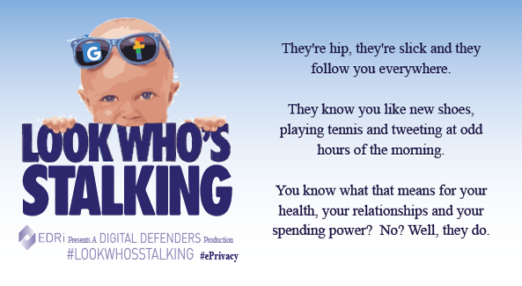
They’re hip, they’re slick and they follow you everywhere. They know you like new shoes, playing tennis and tweeting at odd hours of the morning. Do you know what that says about your health, your relationships and your spending power? No? Well, the online companies do. They follow you everywhere you go online, they have […]
Read more
-
Tear down the tracking wall
It has become a daily routine: “consenting to” being tracked, on the basis of meaningless explanations (or no explanation at all) before you’re allowed access to a website or online service. It’s about time to set limits to this tracking rat race.
Read more
-
The privacy movement and dissent: Art
This is the third blogpost of a series, originally published by EDRi member Bits of Freedom, that explains how the activists of a Berlin-based privacy movement operate, organise, and express dissent. The series is inspired by a thesis by Loes Derks van de Ven, which describes the privacy movement as she encountered it from 2013 […]
Read more
-

Battle lines drawn between citizens and internet giants in EU e-Privacy Regulation
On 2 October, the European Parliament Committee on Legal Affairs (JURI) and the Industry Research and Energy Committee (ITRE) voted on the e-Privacy Regulation, the Committee on Internal Market and Consumer Protection (IMCO) voted on 28 September. These votes will feed into the final decision to be taken by the Committee on Civil Liberties, Justice […]
Read more