
Surveillance and data retention
Surveillance is when an individual or organisation is watching, tracking, filtering, analysing or blocking what you can see and do online or offline. It can be targeted on a specific individual (such as someone suspected of a crime) or it can be done indiscriminately (such as on all users from a particular country), also known as mass surveillance. Surveillance - and the retention of surveillance data - can impose restrictions on our fundamental rights in the digital environment by interfering with our freedom online, or by using digital technology to follow our offline movements, in order to gain an intimate picture of our lives, our beliefs and our interactions.
Filter resources
-

Fighting for migrants’ data protection rights in the UK
Since 2014, the United Kingdon (UK) government has steadily rolled out policies to make the country a “hostile environment” for migrants, in the words of Prime Minister Theresa May.
Read more
-

DPAs require urgent action on air passenger surveillance
The Working Party 29 (WP29) is an advisory body composed of representatives from the data protection authority of each EU Member State, the European Data Protection Supervisor (EDPS) and the European Commission.
Read more
-

Fundamental Rights Agency report: The risks from biometrics and EU IT systems
On 27 March 2018, the Fundamental Rights Agency (FRA) published a report entitled “Under watchful eyes: biometrics, EU IT systems and fundamental rights” . The report analyses the impact of technologies used for immigration and security purposes on the right to privacy and data protection.
Read more
-
SHARE Foundation: Sharing Serbian successes
In this blogpost published on the occasion of the 15th anniversary of EDRi we present our member SHARE Foundation. SHARE Foundation is a Serbian non-profit organisation founded in 2012, with the goal to fight for the public interest in every critical battle affecting digital rights.
Read more
-

IT Pol: Activism made it to the museum
In 2005, Danish EDRi member IT-Political Association of Denmark (IT-Pol) successfully advocated for a resolution (B-103) for open standards in IT systems used by the government, which the Parliament adopted unanimously.
Read more
-

FIPR: Advocacy against the ‘Database State’
In this blogpost published on the occasion of the 15th anniversary of EDRi we present our member FiPR.
Read more
-

Europol: Delete criminals’ data, but keep watch on the innocent
Under the Europol Regulation, the agency must “support Member States' actions in preventing and combating forms of crime” such as terrorism and racism. However, much of the criminality that Europol works on is not harmonised on a EU level.
Read more
-

Data retention “reflection process”: Council working documents
A number of “working documents” discussed as part of the Council of the EU's “reflection process” on the mandatory retention of telecommunications data have been released following an access to documents request submitted to the Council by EDRi member Statewatch.
Read more
-

Portugal: Data retention sent to the Constitutional Court
A new chapter is expected to soon be written in the long battle between lawmakers and the Constitutional Court in Portugal, regarding the intelligence services’ access to data retention. In January 2018, 35 Members of the Parliament (MP) from three parties officially requested the Constitutional Court to provide a rule on the constitutionality of the […]
Read more
-
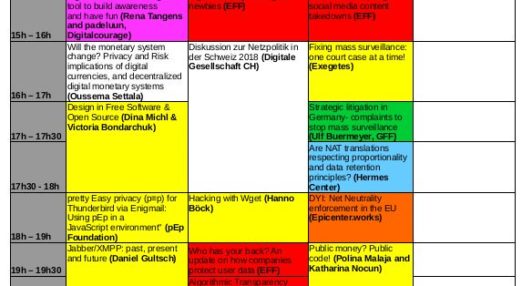
Chaos Communication Congress 2017
The 34th annual four-day hacker conference Chaos Communication Congress (34c3), organised by EDRi member Chaos Computer Club, took place in Leipzig, Germany on 27-30 December 2017. The congress offered lectures, workshops and other events on various topics related to information technology and its effects on the society. For the first time, we also organised an […]
Read more
-

Smashing the law without breaking it: A Commission guide
How to create a general monitoring obligation without creating a general monitoring obligation? That is the question that the Commission has been trying to answer with the Article 13 of its “Proposal for a Directive on Copyright in the Digital Single Market”. It aims at solving the issue of a so-called “value gap”, that is […]
Read more
-

Germany: Constitutional complaint against intelligence agency BND
EDRi observer Gesellschaft für Freiheitsrechte (GFF) has filed a constitutional complaint against surveillance by Germany’s foreign intelligence agency, the Bundesnachrichtendienst (BND). A new law that the German Parliament passed in October 2016 allows the BND to spy on foreign journalists. This destroys trust between journalists and their sources precisely in places where investigative journalism is […]
Read more