
ePrivacy
Filter by...
-

EU Member States willing to retain illegal data retention
With its judgments in April 2014 (Digital Rights Ireland ) and December 2016 (Tele2 ), the Court of Justice of the European Union (CJEU) ruled that blanket data retention was illegal under EU law. Rather than repealing their illegal data retention laws, EU Member States have instead adopted a tactic of ignoring the highest court […]
Read more
-

2019: Important consultations for your Digital Rights!
Public consultations are an opportunity to influence future legislation at an early stage, in the European Union and beyond. They are your opportunity to help shaping a brighter future for digital rights, such as your right to a private life, data protection, or your freedom of opinion and expression.
Read more
-

Digital rights as a security objective: New gateways for attacks
Violations of human rights online, most notably the right to data protection, can pose a real threat to electoral security and societal polarisation.
Read more
-
NGOs urge Austrian Council Presidency to finalise e-Privacy reform
EDRi member epicenter.works, together with 20 NGOs, is urging the Austrian Presidency of the Council of the European Union to take action towards ensuring the finalisation of the e-Privacy reform. The group, counting the biggest civil society organisations in Austria such as Amnesty International and two labour unions, demands in an open letter sent on 6 November 2018 an end to the apparently never-ending deliberations between the EU member states.
Read more
-

CJEU introduces new criteria for law enforcement to access data
On 2 October 2018, the Court of Justice of the European Union (CJEU) delivered a new ruling in the “Ministerio Fiscal” case on access to data retained by electronic communications service providers under the scope the ePrivacy Directive.
Read more
-

ePrivacy: Public benefit or private surveillance?
92 weeks after the proposal was published, the EU is still waiting for an ePrivacy Regulation. The Regulation is supposed to replace the current ePrivacy Directive, aligning it with the General Data Protection Regulation (GDPR).
Read more
-

Council continues limbo dance with the ePrivacy standards
It's been six-hundred-fifty-two days since the European Commission launched its proposal for an ePrivacy Regulation. The European Parliament took a strong stance towards the proposal when it adopted its position a year ago, but the Council of the European Union is still only taking baby steps towards finding its position.
Read more
-

The Facebook breach – a GDPR test-case
On 28 September, Facebook notified the Irish Data Protection Commissioner (DPC) about a massive data breach affecting more than 50 million of its users.
Read more
-

Five reasons to be concerned about the Council ePrivacy draft
The amendments improve the original proposal by strengthening confidentiality requirements for electronic communication services, and include a ban on tracking walls, legally binding signals for giving or refusing consent to online tracking, and privacy by design requirements for web browsers and apps.
Read more
-
Civil society calls for the protection of privacy in ePrivacy
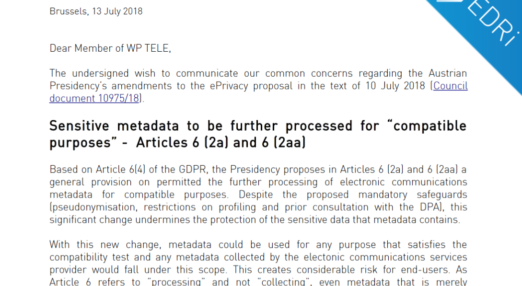
On the 13th of July, EDRi, together with Privacy International, IT-Politisk Forening and Access Now sent a letter to the TELE Working Party of the EU Council regarding the dangers for privacy protections associated with the latest proposals brought forward by the Austrian Council Presidency. The letter comments the developments and argues that such changes […]
Read more
-
Your ePrivacy is nobody else’s business
The right to privacy is a fundamental right for every individual, enshrined in international human rights treaties. This right is being particularly threatened by political and economic interests, which are having a deep impact on freedom of expression, democratic participation and personal security.
Read more
-

A Digestible Guide to Individual’s Rights under GDPR
The General Data Protection Regulation went into effect on May 25th and Privacy Policy updates have been flooding inboxes. GDPR enhances everyone’s rights, regardless of nationality, gender, economic status and so on. Unfortunately, the majority of individuals know very little about these rights and GDPR at large.
Read more