
Privacy
Filter by...
-
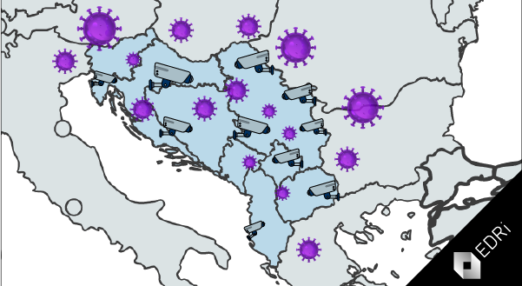
COVID-19 pandemic adversely affects digital rights in the Balkans
Cases of arbitrary arrests, surveillance, phone tapping, privacy breaches and other digital rights violations have drastically increased in Central and Southeast Europe as governments started imposing emergency legislation to combat the COVID-19 outbreak.
Read more
-
Open letter: Civil society urges Member States to respect the principles of the law in Terrorist Content Online Regulation
On 27 March 2020, European Digital Rights (EDRi) and 12 of its member organisations sent an open letter to representatives of Member States in the Council of the EU. In the letter, we voice our deep concern over the proposed legislation on the regulation of terrorist content online and what we view as serious potential threats to fundamental rights of privacy, freedom of expression, etc.
Read more
-

Germany: Invading refugees’ phones – security or population control?
In its new study, EDRi member Society for Civil Rights (GFF) examines how German authorities sniff out refugees’ phones. The aim of “data carrier evaluation” is supposed to be determining a person’s identity and their country of origin. However, in reality, it violates refugees’ rights and does not produce any meaningful results.
Read more
-
Romania: Mandatory SIM registration declared unconstitutional, again
On 18 February 2020, the Romanian Constitutional Court unanimously declared unconstitutional a new legislative act adopted in September 2019 introducing mandatory SIM card registration. The legislative act in question was an emergency ordinance issued by the Government which wanted to introduce this obligation as a measure “to improve the operation of the 112 emergency service […]
Read more
-
The impact of competition law on your digital rights
This is the first article in a series dealing with competition law and Big Tech. The aim of the series is to look at what competition law has achieved when it comes to protecting our digital rights, where it has failed to deliver on its promises, and how to remedy this. This series will first […]
Read more
-

Cloud extraction: A deep dive on secret mass data collection tech
Mobile phones remain the most frequently used and most important digital source for law enforcement investigations. Yet it is not just what is physically stored on the phone that law enforcement are after, but what can be accessed from it, primarily data stored in the “cloud”. This is why law enforcement is turning to “cloud […]
Read more
-

Digitalcourage fights back against data retention in Germany
On 10 February 2020, EDRi member Digitalcourage published the German government’s plea in the data retention case at the European Court of Justice (ECJ). Dated 9 September 2019, the document from the government explains the use of retained telecommunications data by secret services, the question whether the 2002 ePrivacy Directive might apply to various forms […]
Read more
-

CJEU to decide on processing of passenger data under PNR Directive
On 20 January 2020, the District Court of Cologne, Germany, submitted to the Court of Justice of the European Union (CJEU) the question whether the European Passenger Name Record (PNR) Directive violates fundamental rights. EDRi member Gesellschaft für Freiheitsrechte (GFF, Society for Civil Rights) initiated the proceedings against the directive, which allows for authorities to […]
Read more
-

Your face rings a bell: Three common uses of facial recognition
Not all applications of facial recognition are created equal. In this third installment, we sift through the hype to analyse three increasingly common uses of facial recognition: tagging pictures on Facebook, automated border control gates, and police surveillance.
Read more
-

The many faces of facial recognition in the EU
In this second installment of EDRi's facial recognition and fundamental rights series, we look at how different EU Member States, institutions and other countries worldwide are responding to the use of this tech in public spaces.
Read more
-
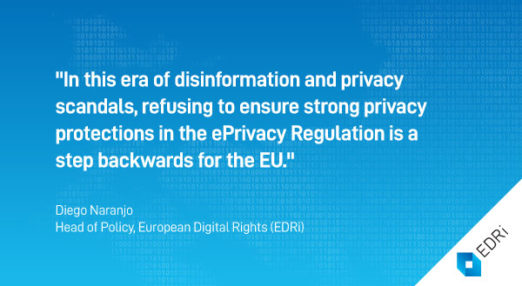
ePrivacy: EU Member States push crucial reform on privacy norms close to a dead end
Today, on 22 November 2019, the Permanent Representatives Committee of the Council of the European Union (COREPER) has rejected the Council’s position on a draft ePrivacy Regulation. “In this era of disinformation and privacy scandals, refusing to ensure strong privacy protections in the ePrivacy Regulation is a step backwards for the EU,” said Diego Naranjo, […]
Read more
-
The sixth attempt to introduce mandatory SIM registration in Romania
A tragic failure by the police to save a teenage girl who was abducted but managed to call the 112 emergency number three times before she was murdered, led to the adoption of a new Emergency Ordinance in Romania. The law introduces several measures to improve the 112 system, one of which is mandatory SIM card registration for all prepaid users. Currently approximately ten million prepaid SIM cards are used in Romania.
Read more