
Our work
EDRi is the biggest European network defending rights and freedoms online. We work to to challenge private and state actors who abuse their power to control or manipulate the public. We do so by advocating for robust and enforced laws, informing and mobilising people, promoting a healthy and accountable technology market, and building a movement of organisations and individuals committed to digital rights and freedoms in a connected world.
Filter resources
-

Cross-border access to data has to respect human rights principles
The Council of Europe started preparing an additional protocol to the Cybercrime Convention – a new tool for law enforcement authorities (LEAs) to have access to data in the context of criminal investigations. Ahead of the first meeting of the Drafting Group, EDRi coordinated a civil society submission, signed by 14 organisations from around the […]
Read more
-

Dutch digital investigation: Pushing the boundaries of legality
The Dutch court is currently considering the case against Naoufal F, in which the police made use of several advanced digital investigation methods that challenge the boundaries of the law. A key issue in the case is the way in which the police gained access to and analysed the secure communication of suspects. Inez Weski, […]
Read more
-

Position Paper: Encryption workarounds and human rights
On 12 September, EDRi published the position paper “Encryption Workarounds: a digital rights perspective”. It was published in response to the European Commission’s expert consultation exercise around the Encryption Workarounds paper by Orin Kerr and Bruce Schneier.
Read more
-

Secret documents reveal: BND attacked Tor and advises not to use it
The German spy agency BND developed a system to monitor the anonymity network Tor and warned federal agencies that its anonymity is “ineffective”. This is what emerges from a series of secret documents published by the German Netzpolitik blog. The spies handed a prototype of this technology over to the US National Security Agency (NSA), […]
Read more
-
Human Rights Court sets limits on right to monitor employees
On 5 September 2017, the Grand Chamber of the European Court for Human Rights (ECtHR) ruled on the Bărbulescu v. Romania case. It found that there was a breach of the right to family life and correspondence (Article 8 of the European Convention on Human Rights), as claimed by Mr Bărbulescu. Mr Bărbulescu was fired […]
Read more
-
FnF 2017: Register for travel support until 22 September!
Freedom not Fear, an annual barcamp organised by EDRi member Digitalcourage for European digital rights activists, takes place in Brussels the weekend of 6-9 October 2017. The event takes place at Mundo B in Brussels and is open for everyone – there are no registrations. Participants that extend their stay to visit the European Parliament […]
Read more
-
Cross-border access to data: EDRi delivers international NGO position to Council of Europe
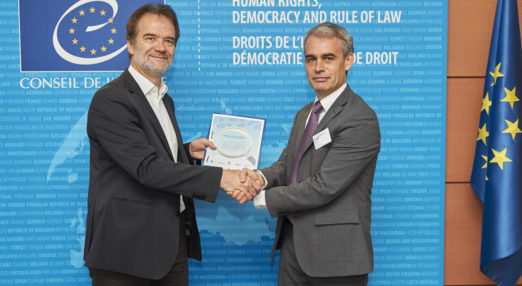
Today, 18 September 2017, a global coalition of civil society organisations, led by European Digital Rights (EDRi), submitted to the Council of Europe its comments on how to protect human rights when developing new rules on cross-border access to electronic evidence (“e-evidence”). The Council of Europe is currently preparing an additional protocol to the Cybercrime […]
Read more
-
Public Money? Public Code!
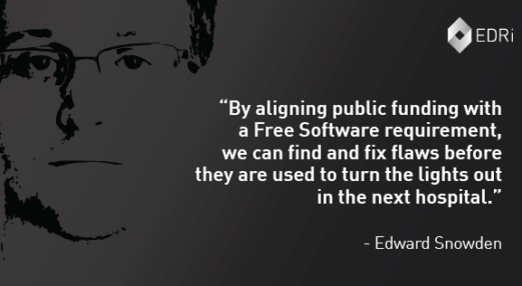
31 organisations ask to improve public procurement of software Today, on 13 September 2017, 31 organisations are publishing an open letter. The letter calls for lawmakers to advance legislation requiring publicly financed software that has been developed for the public sector be made available under a Free and Open Source Software licence. Digital services offered […]
Read more
-

Five things the online tracking industry gets wrong
The Interactive Advertising Bureau (IAB) Europe, one of the loudest enemies of the e-Privacy Regulation, is the association of online tracking and adverting companies. On 7 September, IAB Europe published a report titled: “Europe Online: An experience driven by advertising”. In the report, some of the key issues are clearly displayed, but some are hidden […]
Read more
-

Estonia loves digital – why is it supporting the #censorshipmachine?
Estonia is globally known as a powerhouse of the digital world. It eagerly moves everything into the digital realm and prides itself on being at the forefront of technology. As it now holds the Presidency of the Council of the EU, it is in charge of negotiations on the new Copyright Directive proposal. Knowing how […]
Read more
-
Controversial testing of facial recognition software in Germany
At the end of August 2017, German police has been testing a facial recognition software at Südkreuz train station in Berlin. The system was tested on 300 volunteers. The goal was to evaluate the accuracy of the software in recognising and distinguishing them from the crowd – a feature that the police hopes to ultimately […]
Read more
-
Winter is here
This autumn announces itself much colder and threatening for our rights and freedoms than we thought: The e-Privacy Regulation and copyright reform are the two main pieces of EU legislation that will keep the digital rights defenders of EDRi’s Brussels office busy. We will also continue our work on implementation of the General Data Protection […]
Read more