
Our work
EDRi is the biggest European network defending rights and freedoms online. We work to to challenge private and state actors who abuse their power to control or manipulate the public. We do so by advocating for robust and enforced laws, informing and mobilising people, promoting a healthy and accountable technology market, and building a movement of organisations and individuals committed to digital rights and freedoms in a connected world.
Filter resources
-

Complaints: Google infringes GDPR’s informed consent principle
On 27 November 2018, seven members of the European Consumer Organisation (BEUC) have launched complaints with their national Data Protection Authorities (DPAs) about Google potentially infringing the General Data Protection Regulation (GDPR).
Read more
-

Net Neutrality vs. 5G: What to expect from the upcoming EU review?
Since 2016 the principle of net neutrality is protected in the European Union (EU). Net neutrality is a founding principle of the internet. It ensures the protection of the right to freedom of expression, the right to assembly, the right to conduct business, and the freedom to innovate on the internet. These protections came about […]
Read more
-

Serbian Data Protection Commissioner: NGOs call for transparency
Today, on 4 December, eight digital rights organisations from across Europe sent a letter to the National Assembly of Serbia, asking for a transparent process of the selection of the country’s new Data Protection Commissioner.
Read more
-

Whom do we trust with the collective good?
Wittingly and unwittingly, we increasingly leave the care of society to tech companies. This trend will prove detrimental to us.
Read more
-

#TeleormanLeaks: Privacy vs freedom of expression
The first big General Data Protection Regulation (GDPR) privacy case broke out in Romania at the beginning of November 2018 in connection with an article about a corruption scandal involving a politician and his relationship with a company investigated for fraud.
Read more
-

The TERR Committee votes on its irreparable draft Report
The draft Report of the rather secretive work carried out by the European Parliament’s Special Committee on Terrorism (TERR) released in June 2018 raised major concerns, as previously reported in the EDRi-gram. On 13 November 2018, the members of the TERR Committee voted on the amendments to the draft.
Read more
-
Greece: Clarifications sought on human rights impacts of iBorderCtrl
On 5 November 2018, EDRi observer Homo Digitalis filed a petition to the Greek Parliament about the pilot implementation of the iBorderCtrl project on the Greek border. The Minister in charge will have 25 days to reply to it.
Read more
-

ENDitorial: Facebook can never get it right
In 2017, a man posted live footage on Facebook of a murder he was committing. The platform decides whether you get to see this shocking footage or not – an incredibly tricky decision to make. And not really the kind of decision we want Facebook to be in charge of at all.
Read more
-

Terrorist content regulation – prior authorisation for all uploads?
The European Commission’s proposal for a Regulation on Terrorist Content Online is a complex and multi-layered instrument. On the basis of an “impact assessment” that fails to provide meaningful justification for the measures, it proposes: Obligations to take down content on the basis of removal orders within one hour An arbitrary system of referrals of […]
Read more
-

Letter to the EU Council: Stand for citizen’s rights and the European digital economy in the copyright negotiations!
On 19 November 2018, EDRi, together with 53 other NGOs, sent a letter to the Council of the European Union. The letter draws attention to the ongoing concerns regarding the proposal on copyright in the Digital Single Market, ahead of a crucial meeting on 23 November.
Read more
-
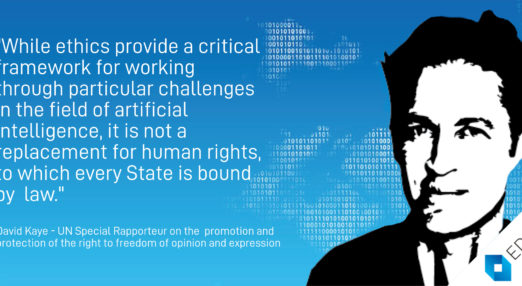
UN Special Rapporteur analyses AI’s impact on human rights
In October 2018, the United Nations (UN) Special Rapporteur for the promotion and protection of the right to freedom of opinion and expression, David Kaye, released his report on the implications of artificial intelligence (AI) technologies for human rights. The report was submitted to the UN General Assembly on 29 August 2018 but has only been published recently.
Read more
-
NGOs urge Austrian Council Presidency to finalise e-Privacy reform
EDRi member epicenter.works, together with 20 NGOs, is urging the Austrian Presidency of the Council of the European Union to take action towards ensuring the finalisation of the e-Privacy reform. The group, counting the biggest civil society organisations in Austria such as Amnesty International and two labour unions, demands in an open letter sent on 6 November 2018 an end to the apparently never-ending deliberations between the EU member states.
Read more