
Our work
EDRi is the biggest European network defending rights and freedoms online. We work to to challenge private and state actors who abuse their power to control or manipulate the public. We do so by advocating for robust and enforced laws, informing and mobilising people, promoting a healthy and accountable technology market, and building a movement of organisations and individuals committed to digital rights and freedoms in a connected world.
Filter resources
-
Safeguarding fundamental rights in the new Cybercrime Protocol
On 20 February, European Digital Rights (EDRi), along with ten civil society organisations from across the globe, responded to a public consultation on the Council of Europe’s Second Protocol to the Convention on Cybercrime (also known as the Budapest Convention). The draft Protocol aims to establish international rules for cross-border access to personal data by […]
Read more
-

Corporate Europe Observatory: e-Privacy Regulation victim of a “lobby onslaught”
On 6 February 2019, Corporate Europe Observatory (CEO) released its report “Captured states: when EU governments are a channel for corporate interests”. The report describes the various ways corporations influence the Member States of the European Union. It shows how they are far better equipped than non-governmental organisations and trade unions to access documents and […]
Read more
-
FRA and EDPS: Terrorist Content Regulation requires improvement for fundamental rights
On 12 February 2019, the European Union Agency for Fundamental Rights (FRA) published an Opinion regarding the Regulation on preventing the dissemination of terrorist content online. In the same day, the European Data Protection Supervisor (EDPS) submitted its comments on the topic to the responsible committee in the European Parliament. These two texts complement EDRi’s […]
Read more
-
Upload filters: history and next steps
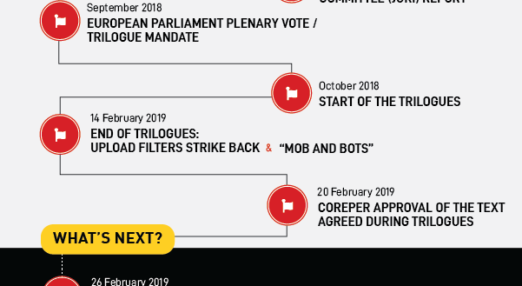
The proposal for a new copyright Directive was originally aimed at modernising the copyright framework. However, it has fallen short of the initial expectations. Instead, the current proposal for the Directive text forces the implementation of upload filters and brings only minor improvements in other areas. In effect, the proposal could lead to unlawful restrictions […]
Read more
-

EDRi’s Press Review 2018
During the past year, our work to defend citizens’ rights and freedoms online has gained an impressive visibility – we counted more than three hundred mentions! – in European and international media. Below, you can find our press review 2018. JANUARY 01/01 EU i linedans mellem desinformation og censur (Mandag Morgen)10/01 Does Software Piracy Hurt Sales? […]
Read more
-

Copyright Directive: Upload filters strike back
The behind-closed-doors discussions between the European Parliament negotiating team, EU Member States and the European Commission on the copyright Directive finalised last night with an agreement. The text, prepared by France and Germany, will be put to a vote between March and April in the European Parliament and could become law soon afterwards. The copyright […]
Read more
-

All Cops Are Blind? Context in terrorist content online
The battle for the control of content and devices online has been at the centre of European policy-makers’ attention since the internet was created, but it has only increased in the recent years. Without any consideration for scientific literature on violent radicalisation factors, the current paradigm in the area of counter-terrorism leads to a proliferation […]
Read more
-

LIBE Committee analysis: Challenges of cross-border access to data
On 7 February, the European Parliament Committee on Civil Liberties, Justice and Home Affairs (LIBE) presented two new working documents analysing further the issue of cross-border access to data in criminal matters, also known as “e-evidence”.
Read more
-

Time for better net neutrality rules
A Dutch court struck a blow against strong net neutrality protections. According to the court, the mobile operator T-Mobile may continue to provide certain music services with preferential treatment to its customers in the Netherlands − a disappointing judgment showing the need for better rules.
Read more
-
EDPB confirms: Privacy Shield is still a shame
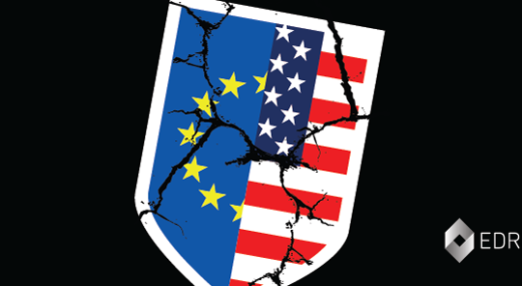
On 22 January 2019, the European Data Protection Board (EDPB) adopted a Report on the Second Annual Review of the EU-US Privacy Shield. The Privacy Shield is a framework arrangement between the United States and the European Union to enable the transmission of personal data from the territory of the EU to the US. It […]
Read more
-

Czech BBA nominates the worst privacy intruders for the 14th time
The 14th Big Brother Awards (BBA) in the Czech Republic will take place on 14 February 2019. Awards for the biggest privacy intruders in 2018 will be announced by EDRi member Iuridicum Remedium (IuRe). The Big Brother Awards, based on a concept created by EDRi member Privacy International, are intended to draw public attention to […]
Read more
-

BBA Bulgaria: Parliament wins the title of top privacy violator
After a six-year hiatus, leading Bulgarian digital rights organisations have revived their country’s version of the Big Brother Awards. Originated by EDRi member Privacy International in 1998, the concept of Big Brother Awards have been adopted by multiple civil society organisations in Europe and beyond. The event aims to increase awareness about the misuse of […]
Read more